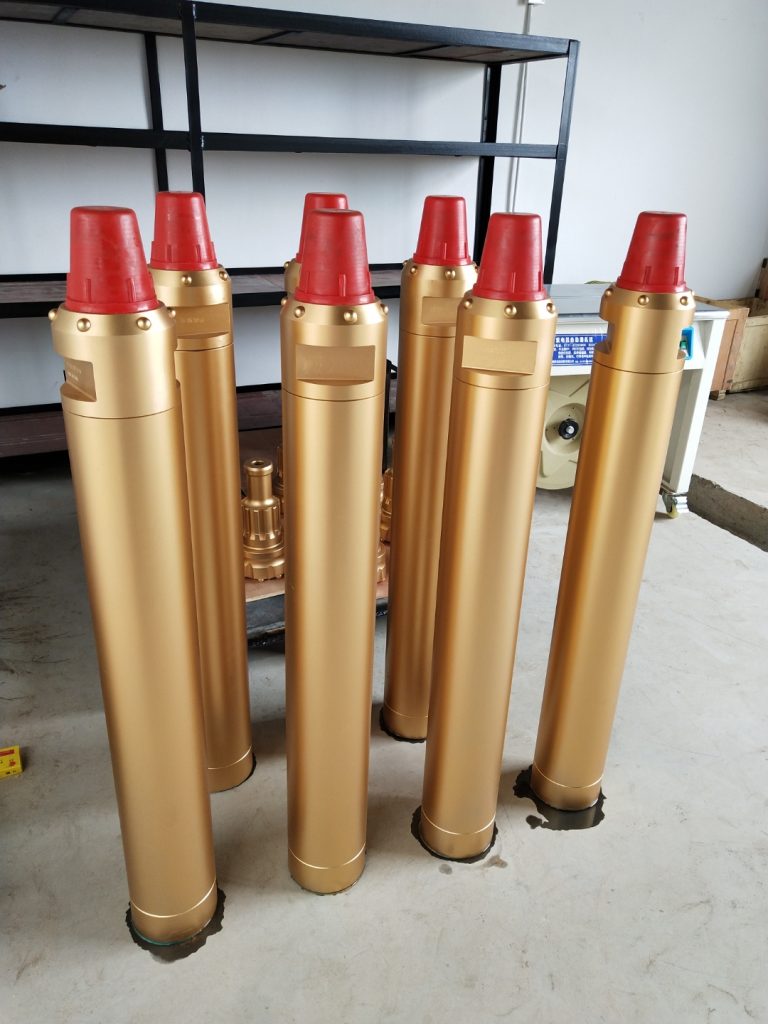

Selecting the appropriate Down-The-Hole (DTH) hammer and drill string is a systematic process critical for optimizing drilling efficiency and minimizing total operating costs. The selection must balance borehole diameter, rock properties, rig capability, and cost-effectiveness.
The Core Selection Process & Considerations:
Step 1: Define the Basic Parameters
- Borehole Diameter: This is the starting point. The hammer and drill pipe OD must match the target hole size.
- Rule of Thumb: Hammer OD ≈ Hole Diameter – (0.5″ to 1″) to ensure sufficient annulus for cuttings removal.
- Drill Rig Capability: Check your rig’s specifications.
- Air Volume (CFM / l/s): Must meet the hammer’s minimum requirement. Insufficient air leads to poor cuttings removal and cooling, causing “plugging”.
- Air Pressure (psi / MPa): Directly affects the hammer’s impact energy and frequency. Rigs with higher pressure (e.g., >350 psi) can use high-performance hammers for higher penetration rates.
- Torque and Pull-Down Force: Must be sufficient to rotate the chosen drill string and provide adequate bit pressure.
Step 2: Select the Hammer Based on Rock Properties
DTH hammers are designed for different rock formations:
- Low-Pressure Hammers: For rigs operating at 100-200 psi, best for soft to medium formations (e.g., limestone, sandstone).
- Medium-/High-Pressure Hammers: For rigs operating at 200-350 psi. This is the most common range, suitable for medium to hard rock (e.g., granite, marble).
- High-Pressure/High-Volume Hammers: For high-performance rigs (>350 psi). Designed for very hard and abrasive formations (e.g., quartzite, basalt, taconite). They deliver high impact energy but require massive air supply.
- Valved vs. Valveless Design:
- Valved Hammers: Simpler design, easier to maintain, good performance at medium pressures.
- Valveless Hammers: The modern standard for high performance. They use expanding air more efficiently, providing higher blow frequency and energy at elevated pressures, making them superior for hard rock.
Step 3: Select the Matching Drill String
The drill string (rods and hammer outer casing) must be perfectly compatible with the hammer.
- Thread Type: This is critical for compatibility! Ensure threads match between the hammer, drill rods, and adaptors.
- REG (Regular): Robust square threads, widely used.
- API (American Petroleum Institute): Tapered threads, common in oil & gas and large drilling.
- COP: Atlas Copco’s proprietary thread.
- SD/SDK: Sandvik’s proprietary thread.
- Other Brand-Specific Threads.
- Warning: Threads from different brands are generally not compatible. Use adaptors or stick to a complete system from one manufacturer.
- Drill Pipe Size & Material:
- Diameter: The rod OD should be close to the hammer OD to minimize hole deviation.
- Wall Thickness: Thicker walls offer better bending resistance and longer life but add weight.
- Material: Use high-strength, wear-resistant alloy steel. Hard surface treatments (e.g., chrome plating) significantly improve abrasion resistance and service life.
- Matching Drill Bit:
- The bit’s shank thread must exactly match the hammer’s drive chuck thread.
- The bit’s button layout and carbide grade must be selected for the rock hardness.
Practical Advice & Summary:
- Consult Your Supplier: Provide your working conditions (rock type, hole size, rig model) to a specialist supplier (e.g., Hubei Xinlonggang Engineering Machinery Co., Ltd.). They can recommend the optimal product combination.
- Think in Systems: The hammer, drill pipe, and bit should be considered as an integrated system. Mixing and matching brands often leads to subpar performance and failures.
- Calculate Total Cost: Don’t just look at the unit price. Calculate the Cost-Per-Meter (CPM):
(Hammer cost + Drill String cost + Bit cost + Downtime cost) / Total Meters Drilled. A more expensive but longer-lasting and efficient system often has a lower total cost. - Consider the Bit First: Sometimes, it’s effective to first identify the best bit brand/design for your rock, and then select the hammer and drill string system compatible with that bit.
Final Checklist:
Is the drill string strong enough for the hole depth and my rig’s capabilities?
Does the hammer match the desired hole size?
Does my rig provide enough air CFM and pressure for the hammer?
Is the hammer type suited to my rock hardness?
Are all threads compatible? (Hammer ↔ Rods, Hammer ↔ Bit)